
Carter Federal Custody Path
Carter County Detention Center can hold people associated with federal proceedings, but departure from CCDC does not establish release into the community. A pretrial detainee may move under United States Marshals Service authority to another contract jail or court location. A sentenced person may later enter Bureau of Prisons custody. CCDC records the local departure, while the federal system records the later federal stage.
A dated Kentucky DOC jail report listed 45 federal inmates at CCDC on July 10, 2025. That is a point-in-time category, not a current count and not proof that any named person belonged to BOP, USMS, or ICE. The category also cannot be converted into an immigration claim. Person-specific identifiers and records must control.
Find BOP Released Records
The BOP Inmate Locator is the main public route for a sentenced person who entered Bureau custody. Search by BOP register number, FBI number, INS number, or DCDC number when available. A name search can also use age, race, and sex to narrow the result. Match the register number and identity before relying on a release date.
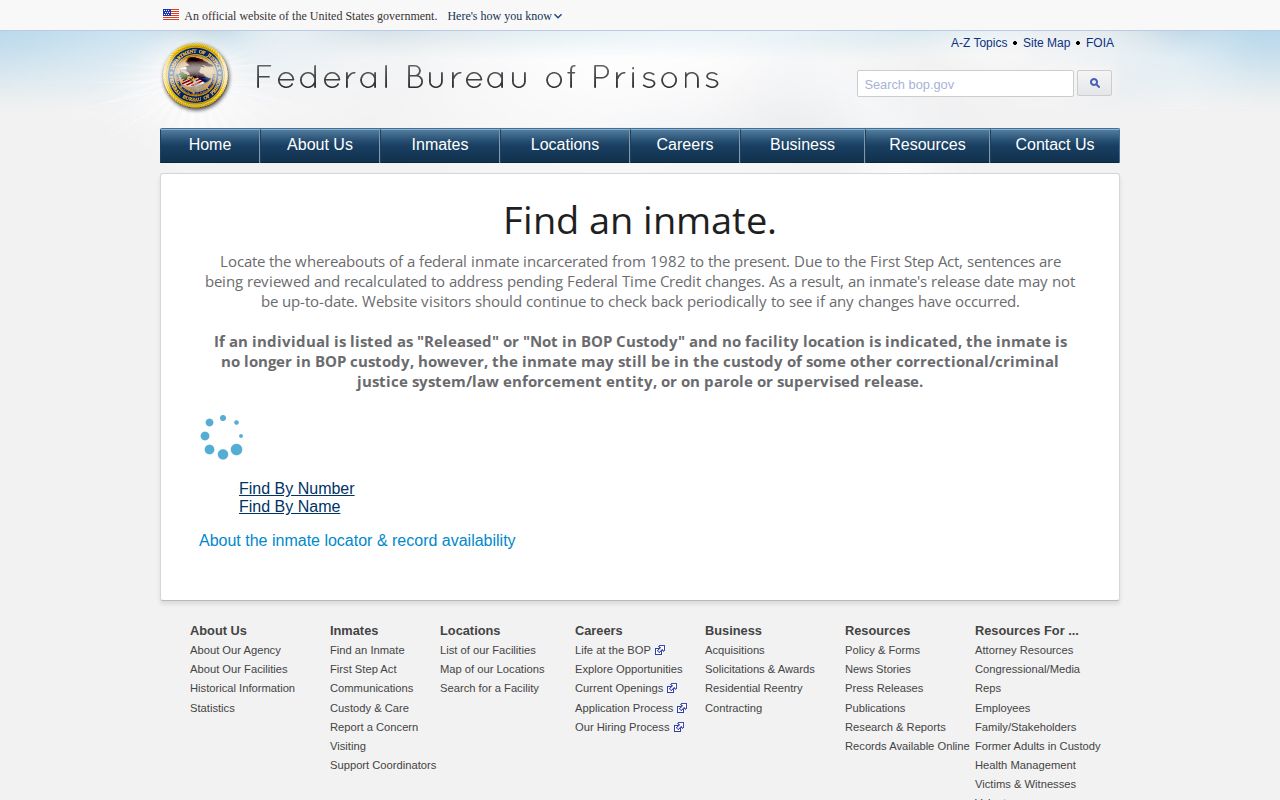
The captured locator shows the federal search route. Results can include name, register number, age, race, sex, release date, and location. BOP explains that a past date, no facility, and “RELEASED” mean the person is no longer in BOP custody. That status does not establish that federal supervised release ended, that no state warrant exists, or that another authority did not assume custody.
Interpret Federal Release Results
Federal status must be read within its stated scope. The BOP locator proves a Bureau custody result. The federal judgment and docket explain the sentence, release order, and any supervised-release term. CCDC can establish an earlier local transfer date. Those records can describe different moments and remain consistent.
| Record | What it establishes |
|---|---|
| CCDC release or movement entry | The end of the Carter facility event and any recorded receiving agency. |
| Federal docket or judgment | Court authority, sentence, release order, and supervised-release terms. |
| BOP locator | Bureau identity, location or “RELEASED” status, and public release date. |
| USMS records | Pretrial prisoner tracking and movements not shown by a public locator. |
| ICE locator | A separate immigration path only when individual evidence supports it. |
“Not in BOP custody” is narrower than “not in custody.” Federal supervised release is a court-managed period after incarceration. It does not place the person back in prison, yet it remains a legal status. A later state or immigration hold can also follow the BOP event.
Federal Pretrial Release Checks
The United States Marshals Service manages many federal prisoners pending proceedings, but its Prisoner Tracking System is internal. There is no comparable public USMS released-person locator. A pretrial detainee released before BOP designation may never receive a useful BOP locator result.
- Obtain the federal case number and exact identity from the docket or known paperwork.
- Check the docket for detention, bond, release, sentencing, commitment, and transfer entries.
- Ask CCDC for the local booking end, disposition, and receiving agency if the person was held there.
- Use BOP only if sentenced Bureau custody likely followed.
- Send a narrow USMS FOIA request when the public docket and local record do not resolve a pretrial movement.
A no-result BOP search can mean pretrial-only USMS custody, release before Bureau designation, an identity mismatch, an older record, or another agency path. It should not be stated as proof that the person was never federally detained.
BOP Release Date Limits
BOP data is updated daily and generally covers federal releases after 1982. Older federal records may require the National Archives. The public release date can also be recalculated. Preserve the date checked and the exact displayed label.
The BOP locator records explanation describes the limits of the public data.
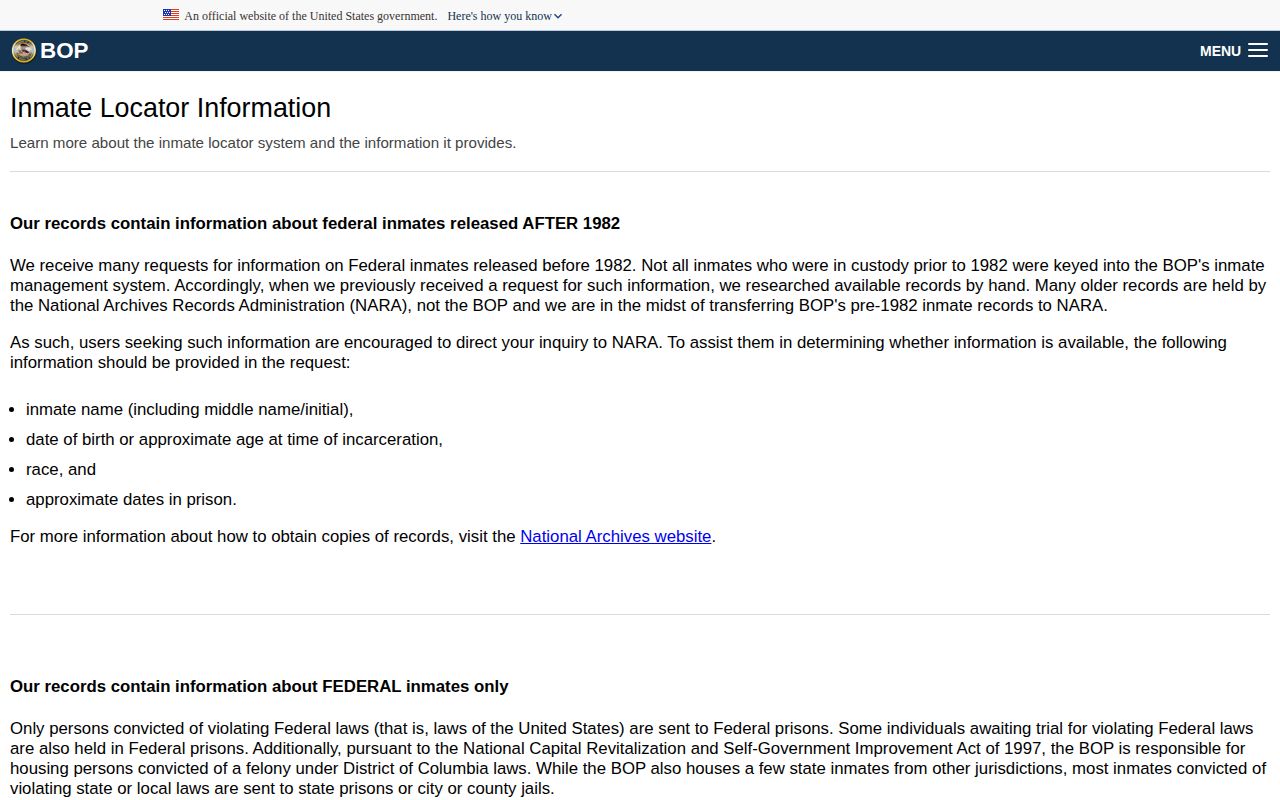
The explanation supplies the proper scope for a result. A projected or anticipated date should not be reported as an actual release. After the expected event, verify that the locator changed, review the docket, and obtain the relevant agency record if the date or status matters.
Carter Federal Transfer Evidence
Start with the CCDC booking or release entry when the person was held locally. Ask for admission and departure timestamps, the recorded disposition, destination, and receiving agency. The local record can establish transfer to federal authority even when it cannot describe later federal movements.
The federal docket should then be searched by case number. A bond or release order establishes legal authority but may precede physical processing or coexist with another hold. A commitment or remand entry can explain why the person remained in custody. “Remand” means the court ordered continued detention or returned the person to custody.
For a sentenced person, match the docket identity to the BOP register number. If BOP shows “RELEASED,” record the public release date and then read the judgment for supervised release. Do not ask Carter County to certify a later BOP release. Each custodian should confirm its own event.
Request Federal Custody Records
A useful request names the person, federal case number, register number if assigned, the Carter booking dates, and a narrow movement range. Ask USMS for releasable prisoner-processing or movement records when pretrial custody is at issue. Ask BOP for its custody and release record when Bureau designation occurred.
Requests should seek existing records rather than answers to broad questions. Relevant items can include commitment documents, movement dates, release date, release authority, and transfer destination, subject to lawful withholding. Preserve the request, delivery proof, and agency response.
Federal FOIA response rules differ from Kentucky open-records procedures. The Carter jail request remains subject to Kentucky law, while the federal request goes to the federal agency. Sending one request to the wrong custodian delays the result because CCDC does not own BOP history and BOP does not own Carter booking execution.
Federal Versus ICE Custody
Federal criminal custody and civil immigration custody are not interchangeable. USMS generally handles people in federal criminal proceedings. BOP handles many sentenced federal prisoners. ICE handles immigration detention. A person can move between authorities, but a federal inmate label alone identifies none of those details.
If a person-specific ICE detainer is documented, ordinary local release may become a DHS handoff. ICE asks a jail to maintain custody for up to 48 hours beyond the ordinary point so DHS can assume custody. No Carter ICE contract or dedicated immigration facility was verified.
Use ICE ODLS only when individual facts justify it. Its released-person visibility is limited to about 60 days. A BOP “RELEASED” result also does not exclude later immigration custody, just as it does not exclude state custody.
Federal Release Proof Chain
A sound Carter-linked federal conclusion states each event in sequence: arrest or booking, CCDC departure, federal transfer or court action, BOP designation if any, BOP release if shown, and supervised release if ordered. Dates and labels should remain tied to their source.
- Transfer
- Movement into another authority’s custody, not community release.
- Release
- The stated end of a particular agency’s custody.
- Supervised release
- A federal court-ordered term in the community after incarceration.
- Detainer
- A request or hold tied to another authority’s custody interest.
A historical search also has limits. BOP generally covers releases after 1982, while an older federal record may require the National Archives. A person released before BOP designation may require the federal docket and USMS route instead. Search dates should be saved because daily systems can later change.
The Carter County released inmate search supplies the county, state, and notification paths that may intersect with a federal case. Use the federal route only for the part of the custody chain it actually covers.